| Home Karaoke Equpment |
In the past, many salaried workers often went to Mahjong or Karaoke after drinking. After retirement, I went to Karaoke with my family once in a few months. However, when I reached 70 years old I started to feel bored going to Karaoke, and I was wondering if I could manage Karaoke alone at home. The first thing to think about is how to sing by echoing after erasing the sound of the CD. A key control function is also needed. After a month or so, I managed to finish a home Karaoke machine, but there was no screen in which lyrics appeared like normal Karaoke, so it's hard to sing. For this reason my family will not use it anyone. However, recently I learned that there is free Karaoke using Youtube on the Internet. Most Japanese popular songs are complete, and the color of the lyrics on the screen changes like Karaoke. So I tried to make the home Karaoke machine using a personal computer. Since the sound coming out of small speakers of the personal computer is not so good, after amplifying with the amplifier via the USB-DAC from the USB output terminal, the external speaker is sounded.
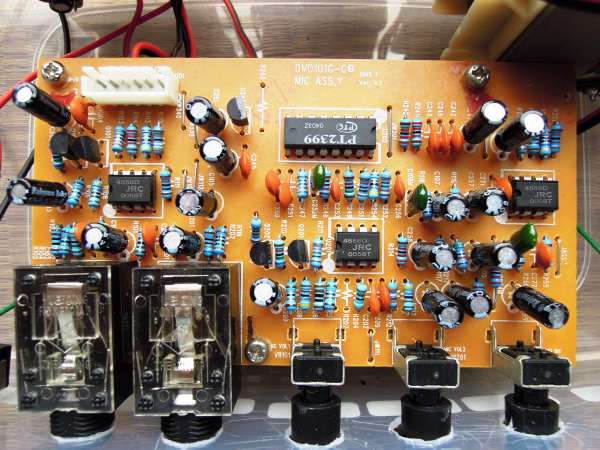 It is a microphone amplifier board with echo I previously bought. I thought if the echo
is applied to the voice on amateur radio communication, it will be nice. But I stopped using it
because I would be embarrassed. Two microphone inputs, three
JRC 4558D as signal amplification IC, and classic IC for echo generation PT2399 are used. Performance
is unknown, but when I connected it to the power supply of ± 12 V experimentally, it turned out
that the noise was very small and it could be used enough for Karaoke amplifier. There are 3 volumes,
from the left, 2 volumes for the microphone 1 and 2, the one for echo adjustment.
It is a microphone amplifier board with echo I previously bought. I thought if the echo
is applied to the voice on amateur radio communication, it will be nice. But I stopped using it
because I would be embarrassed. Two microphone inputs, three
JRC 4558D as signal amplification IC, and classic IC for echo generation PT2399 are used. Performance
is unknown, but when I connected it to the power supply of ± 12 V experimentally, it turned out
that the noise was very small and it could be used enough for Karaoke amplifier. There are 3 volumes,
from the left, 2 volumes for the microphone 1 and 2, the one for echo adjustment.
If you put the mouse, it will be enlarged. (Same below)
 Following the wiring of mike amplifier board with echo, I created a circuit diagram. Maybe there
are mistakes as wiring is complicated. After amplifying the microphone signal 1 (5.6 times) with
half of 4558D, amplifying it by half (5.7 times), synthesizing the microphones 1 and 2, applying
echo with PT2399 and then half of 4558D (12.9 times, the second half is not used) to amplify.
In addition, the amplitude limit (Automatic Level Control) is performed so that the Darlington
amplifier of transistor 2N2222 feeds back to the input of the first stage 4558D and does not
output more than a certain value. Also, when I unplug the microphone jack, the input terminal
drops to the ground, so it is devised so that unnecessary pop noise does not come out.
Following the wiring of mike amplifier board with echo, I created a circuit diagram. Maybe there
are mistakes as wiring is complicated. After amplifying the microphone signal 1 (5.6 times) with
half of 4558D, amplifying it by half (5.7 times), synthesizing the microphones 1 and 2, applying
echo with PT2399 and then half of 4558D (12.9 times, the second half is not used) to amplify.
In addition, the amplitude limit (Automatic Level Control) is performed so that the Darlington
amplifier of transistor 2N2222 feeds back to the input of the first stage 4558D and does not
output more than a certain value. Also, when I unplug the microphone jack, the input terminal
drops to the ground, so it is devised so that unnecessary pop noise does not come out.
 When I searched the Internet, I found that ICs of BA3837 (ROHM) and M65847AFP (MITSUBISHI) can be
obtained for vocal cancellation and key control respectively. These ICs are sold at a low price,
but since the M65847AFP is an SOP type with small size, it was very difficult to solder. I think
there is a substrate for conversion of SOP-DIP but because it is expensive, poor man never buy it.
By the way, BA3837 is 150 yen per piece, M65847AFP is about 180 yen. I bought two each for
destruction accident.
When I searched the Internet, I found that ICs of BA3837 (ROHM) and M65847AFP (MITSUBISHI) can be
obtained for vocal cancellation and key control respectively. These ICs are sold at a low price,
but since the M65847AFP is an SOP type with small size, it was very difficult to solder. I think
there is a substrate for conversion of SOP-DIP but because it is expensive, poor man never buy it.
By the way, BA3837 is 150 yen per piece, M65847AFP is about 180 yen. I bought two each for
destruction accident.
 This is a circuit diagram of a vocal canceller using BA3837 created with reference to the
application example of the data sheet. The operation mode can be changed by the voltage applied
to pins 14 to 16. According to the data sheet, it seems that the vocal suppression ratio around
1 kHz can be taken about -30 dB (1/30 in voltage ratio) by adopting the 2nd order LPF. When not
using the karaoke microphone amp, it has a built-in relay that passes the signal from the CD.
This is a circuit diagram of a vocal canceller using BA3837 created with reference to the
application example of the data sheet. The operation mode can be changed by the voltage applied
to pins 14 to 16. According to the data sheet, it seems that the vocal suppression ratio around
1 kHz can be taken about -30 dB (1/30 in voltage ratio) by adopting the 2nd order LPF. When not
using the karaoke microphone amp, it has a built-in relay that passes the signal from the CD.
 This is a circuit diagram of the key controller using M65847 which was made referring to the
application example of the data sheet. Self-mode, serial mode, and parallel mode can be selected
by the voltage applied to pins 27 and 28. This circuit is a self mode that does not require a
microcomputer, and it performs a key up / down operation with a push switch. The key is changed
in 0 ± 4 steps, and the LED of KEY 5 lights only when it is a minus key. Pressing the two
switches at the same time resets it to the 0 position.
This is a circuit diagram of the key controller using M65847 which was made referring to the
application example of the data sheet. Self-mode, serial mode, and parallel mode can be selected
by the voltage applied to pins 27 and 28. This circuit is a self mode that does not require a
microcomputer, and it performs a key up / down operation with a push switch. The key is changed
in 0 ± 4 steps, and the LED of KEY 5 lights only when it is a minus key. Pressing the two
switches at the same time resets it to the 0 position.
 The operation mode of the vocal canceller is switched by the rotary switch of 3 circuits 4
contacts. If I set + 5V to 1 and 0 V to 0, I will enter through mode with "011", vocal
canceling mode with "001", L + R with key control with "111", vocal canceling mode with key
control with "101". Also, to prevent the LED lamp indicating the key status from turning on
when the key control operation is off, the LED lamp is turned on so that the vocal cancellation
operation is lit.
The operation mode of the vocal canceller is switched by the rotary switch of 3 circuits 4
contacts. If I set + 5V to 1 and 0 V to 0, I will enter through mode with "011", vocal
canceling mode with "001", L + R with key control with "111", vocal canceling mode with key
control with "101". Also, to prevent the LED lamp indicating the key status from turning on
when the key control operation is off, the LED lamp is turned on so that the vocal cancellation
operation is lit.
 It is the vocal canceller board that I made. I made it with a printed circuit board and
old hand-held parts.
It is the vocal canceller board that I made. I made it with a printed circuit board and
old hand-held parts.
 It is the key controller board which I made. It contains + 5V stabilization circuit. It is very
dirty because it wired without using SOP-DIP conversion board. I soldered a thin cable to the
foot of the IC in a super analog manner and wired it to the printed circuit board. There is
also worry that soldering can be taken off for many years due to vibration and deterioration,
but let's try.
It is the key controller board which I made. It contains + 5V stabilization circuit. It is very
dirty because it wired without using SOP-DIP conversion board. I soldered a thin cable to the
foot of the IC in a super analog manner and wired it to the printed circuit board. There is
also worry that soldering can be taken off for many years due to vibration and deterioration,
but let's try.
 It is the front of the completed home Karaoke microphone amplifier. The case is from 100 yen shop.
Although the microphone is cheap, it is not perfect yet, but I am secretly enjoying Karaoke by
connecting to a tube amplifier. Since there is no picture at all, nobody of my family wants to
use yet. Although vocal cancellation has a considerable effect, it does not completely disappear.
If the CD source is monaural, all sounds will be smaller. Echo and key control are satisfactory
performance as hand-made. It is very useful because I can’t sing well unless I lower the key
because I am a bad singer. Overall, since this Karaoke machine sounds like a lack of treble,
I am planning to get it even with SHURE's famous vocal microphone (SM 58?).
It is the front of the completed home Karaoke microphone amplifier. The case is from 100 yen shop.
Although the microphone is cheap, it is not perfect yet, but I am secretly enjoying Karaoke by
connecting to a tube amplifier. Since there is no picture at all, nobody of my family wants to
use yet. Although vocal cancellation has a considerable effect, it does not completely disappear.
If the CD source is monaural, all sounds will be smaller. Echo and key control are satisfactory
performance as hand-made. It is very useful because I can’t sing well unless I lower the key
because I am a bad singer. Overall, since this Karaoke machine sounds like a lack of treble,
I am planning to get it even with SHURE's famous vocal microphone (SM 58?).
 It is the back of the completed home Karaoke microphone amplifier. The 20 kΩ volume for
music volume adjustment was installed on the back as there was no place to install in front.
RCA jack is also broken amplifier's waste use.
It is the back of the completed home Karaoke microphone amplifier. The 20 kΩ volume for
music volume adjustment was installed on the back as there was no place to install in front.
RCA jack is also broken amplifier's waste use.
 It is inside the completed home Karaoke microphone amplifier. The power supply transformer is
a thing taken out by breaking the cheap AC adapter (DC output 14 V 500 mA). A stable DC ±
12 V is obtained with 3-terminal regulators 7812 and 7912. I used most of the parts from
hand-held, so I bought new parts for about 1,500 yen.
It is inside the completed home Karaoke microphone amplifier. The power supply transformer is
a thing taken out by breaking the cheap AC adapter (DC output 14 V 500 mA). A stable DC ±
12 V is obtained with 3-terminal regulators 7812 and 7912. I used most of the parts from
hand-held, so I bought new parts for about 1,500 yen.
 Finally I bought a SHURE’s vocal microphone SM58S. Since it is possible to grab fake products
made in China when it is an online auction, I bought it from "Sound House". Although it was a
microphone with a switch, it was in the 12,000 yen range with postage included. Although I saw
it by using it immediately, the difference in sound quality with the microphone of 2,000 yen
is not clearly understood to the karaoke tone daughter I do not have a collapse in the sound
even when it makes a loud voice. Although it is distorted immediately by a cheap microphone,
SM58S has no problem at all. It seems that probably because it loses sensitivity. Well, next
time I wanted lyrics collection of Japanese traditional ballad songs. Actually, as many of
the CDs I have are copies of the rental CD there is no lyrics. First of all, I will search
for a secondhand bookstore if I can not get it by looking at the bookstore.
Finally I bought a SHURE’s vocal microphone SM58S. Since it is possible to grab fake products
made in China when it is an online auction, I bought it from "Sound House". Although it was a
microphone with a switch, it was in the 12,000 yen range with postage included. Although I saw
it by using it immediately, the difference in sound quality with the microphone of 2,000 yen
is not clearly understood to the karaoke tone daughter I do not have a collapse in the sound
even when it makes a loud voice. Although it is distorted immediately by a cheap microphone,
SM58S has no problem at all. It seems that probably because it loses sensitivity. Well, next
time I wanted lyrics collection of Japanese traditional ballad songs. Actually, as many of
the CDs I have are copies of the rental CD there is no lyrics. First of all, I will search
for a secondhand bookstore if I can not get it by looking at the bookstore.
 Well, although home Karaoke using the CD became possible, it is very inconvenient that there
was no image in which the lyrics appear like normal Karaoke anyhow, the voice canceller could
not completely. So I challenged standard Karaoke using Youtube. Since the sound coming out
from the speaker of the PC is not so good, it uses the USB-DAC, and it is composed of the
microphone amplifier + power amplifier + external speaker. The picture shows the assembled
USB-DAC kit called PS-3249R which I bought for Amazon at 3,650 yen. As the work is just
soldering resistors, capacitors, transistors etc., assembly time is 1 to 2 hours. The
digital signal from the USB output terminal of the PC is converted from the digital signal
to the analog signal, then it comes out from the audio output terminal. Power supply is
unnecessary because it can take from USB bus and installation of driver is also unnecessary.
Well, although home Karaoke using the CD became possible, it is very inconvenient that there
was no image in which the lyrics appear like normal Karaoke anyhow, the voice canceller could
not completely. So I challenged standard Karaoke using Youtube. Since the sound coming out
from the speaker of the PC is not so good, it uses the USB-DAC, and it is composed of the
microphone amplifier + power amplifier + external speaker. The picture shows the assembled
USB-DAC kit called PS-3249R which I bought for Amazon at 3,650 yen. As the work is just
soldering resistors, capacitors, transistors etc., assembly time is 1 to 2 hours. The
digital signal from the USB output terminal of the PC is converted from the digital signal
to the analog signal, then it comes out from the audio output terminal. Power supply is
unnecessary because it can take from USB bus and installation of driver is also unnecessary.
 I put the USB-DAC board inside the microphone amplifier. Even if it is said to be insulated it
is simply fixed on a paper. Since it was housed inside, RCA cable between USB-DAC and microphone
amplifier became unnecessary. Be careful as one side of the USB cable connecting the personal
computer and the USB-DAC is a Mini-B type. If I plug in the USB cable, the computer will
automatically load it, but there is work to check if it is recognized by the computer. The
task of "setting the USB AUDIO DAC as the default device" is a little troublesome work for
me, but finally it went well. After this work is finished, when I plug in the USB cable,
the sound comes out from the external speaker, and when I unplug the USB cable, the sound
will come out from the speaker of the PC as before.
I put the USB-DAC board inside the microphone amplifier. Even if it is said to be insulated it
is simply fixed on a paper. Since it was housed inside, RCA cable between USB-DAC and microphone
amplifier became unnecessary. Be careful as one side of the USB cable connecting the personal
computer and the USB-DAC is a Mini-B type. If I plug in the USB cable, the computer will
automatically load it, but there is work to check if it is recognized by the computer. The
task of "setting the USB AUDIO DAC as the default device" is a little troublesome work for
me, but finally it went well. After this work is finished, when I plug in the USB cable,
the sound comes out from the external speaker, and when I unplug the USB cable, the sound
will come out from the speaker of the PC as before.
 I put the power amplifier in the plastic case bought at the 100 yen shop. The power amplifier
is old digital amplifier called TA-2020-020. Although it is ultra-compact, it has output of
about 10 W and has little heat generation.
I put the power amplifier in the plastic case bought at the 100 yen shop. The power amplifier
is old digital amplifier called TA-2020-020. Although it is ultra-compact, it has output of
about 10 W and has little heat generation.
 It is completion of home Karaoke machine while watching the personal computer screen. The speaker
is 101MM of BOSE. Echo is applied and key control is also possible. The sound quality and noise
are greatly improved compared with the sound coming out from the small speaker of personal
computer. For that reason, my family has started showing interest a little.
It is completion of home Karaoke machine while watching the personal computer screen. The speaker
is 101MM of BOSE. Echo is applied and key control is also possible. The sound quality and noise
are greatly improved compared with the sound coming out from the small speaker of personal
computer. For that reason, my family has started showing interest a little.
 After that, I improved the system so that I can sing on the big screen of the terrestrial
digital TV. I just connected the personal computer and terrestrial digital TV with a 3 m
long HDMI cable. With the HDMI connection left as it is, the sound comes out from the TV side,
so I changed the sound setting. That is to change the control panel → sound → speaker
from HDMI side to PC side. I can only sing "Japanese traditional ballad songs", but my house
is disappointing that I can only sing at low volume dew to low soundproofing effect.
After that, I improved the system so that I can sing on the big screen of the terrestrial
digital TV. I just connected the personal computer and terrestrial digital TV with a 3 m
long HDMI cable. With the HDMI connection left as it is, the sound comes out from the TV side,
so I changed the sound setting. That is to change the control panel → sound → speaker
from HDMI side to PC side. I can only sing "Japanese traditional ballad songs", but my house
is disappointing that I can only sing at low volume dew to low soundproofing effect.