| JBL Speaker System |
 A man who has an audio hobby and loves jazz music usually wants to buy JBL speaker.
But it is too expensive even though it is used one. Therefore I decided to get JBL speaker units by net auction
and to make their enclosure.
The speaker system shall be a combination of a woofer of 38cm (15-inch) and a compression driver with horn.
After one month's auction battle, I got a pair of four kinds of JBL speaker units as shown in the photo.
All units were manufactured 25 years before.
A man who has an audio hobby and loves jazz music usually wants to buy JBL speaker.
But it is too expensive even though it is used one. Therefore I decided to get JBL speaker units by net auction
and to make their enclosure.
The speaker system shall be a combination of a woofer of 38cm (15-inch) and a compression driver with horn.
After one month's auction battle, I got a pair of four kinds of JBL speaker units as shown in the photo.
All units were manufactured 25 years before.
Woofer: 2231H 38cm 8 Ohms 12,000Gauss Weight 10.1kg 25~2,000Hz Sound pressure 94dB/W/m New edge
Driver: 2421A one inch 8 Ohms 15,000Gauss Weight 5kg 800~20,000Hz Sound pressure 110dB/W/m
Horn: 2345 Horizontal directivity 90 Degrees Virtical directivity 40 Degrees Weight 6.6kg
Network: 3110 Max. input power 100W Low range 8~16 Ohms High range 16 Ohms Cross-over frequency 800 Hz
If you put the mouse on the image, it will be
enlarged. (Same below)
 I measured the frequency response characteristic of 3110 network.
The cross-over frequency seems to be 750 Hz. The 3110 network has an attenuator switch for high
frequency range, Max (4dB), Med (6dB) and Low (9dB).
I measured the frequency response characteristic of 3110 network.
The cross-over frequency seems to be 750 Hz. The 3110 network has an attenuator switch for high
frequency range, Max (4dB), Med (6dB) and Low (9dB).
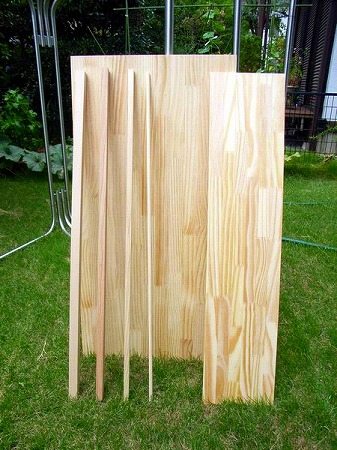 These are wooden materials of the enclosure. The dimension of main wood panel is 91cm x
45cm x 1.8cm.
Wood panel for the bass reflection duct is 91cm x 20cm x 1cm.
These are wooden materials of the enclosure. The dimension of main wood panel is 91cm x
45cm x 1.8cm.
Wood panel for the bass reflection duct is 91cm x 20cm x 1cm.
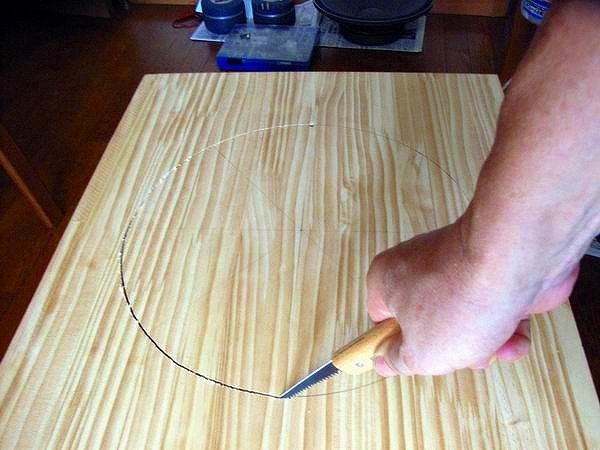 This is hole opening scene for the woofer with 35cm diameter.
Since I have no money to buy a zig-saw, it is manual labor.
The rectangler hole (20cm x 8cm) for bass reflection is made similarly.
This is hole opening scene for the woofer with 35cm diameter.
Since I have no money to buy a zig-saw, it is manual labor.
The rectangler hole (20cm x 8cm) for bass reflection is made similarly.
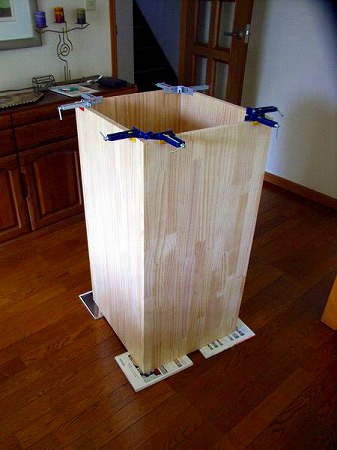 It is adhesion of the main part by right-angled tools.
Its strength seems to be satisfactory although it was a method of not using nails.
It is adhesion of the main part by right-angled tools.
Its strength seems to be satisfactory although it was a method of not using nails.
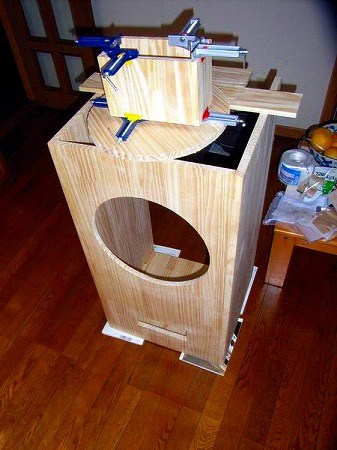 It is adhesion of the duct part by right-angled tools.
The dimension of duct is 20cm (W) x 8cm (H) x 15cm (D).
The resonance frequency is expected to be 35 Hz from the calculation.
It is adhesion of the duct part by right-angled tools.
The dimension of duct is 20cm (W) x 8cm (H) x 15cm (D).
The resonance frequency is expected to be 35 Hz from the calculation.
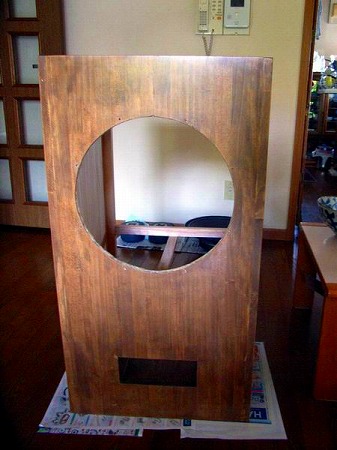 This is enclosure after oil-finished painting.
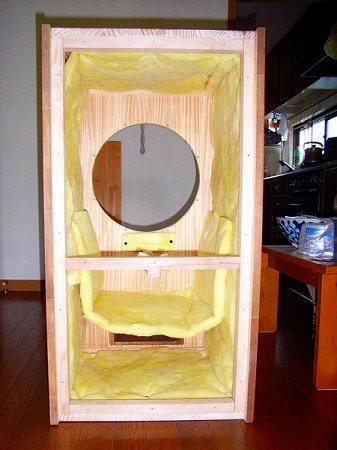 This photo shows glass-wool for the sound absorption.
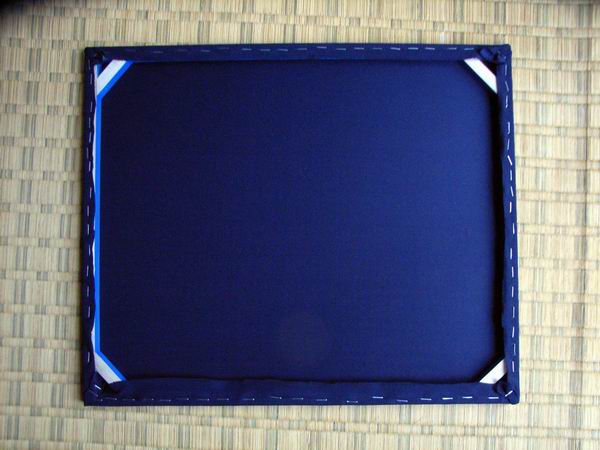 This is the front grill with navy color to cover the woofer.
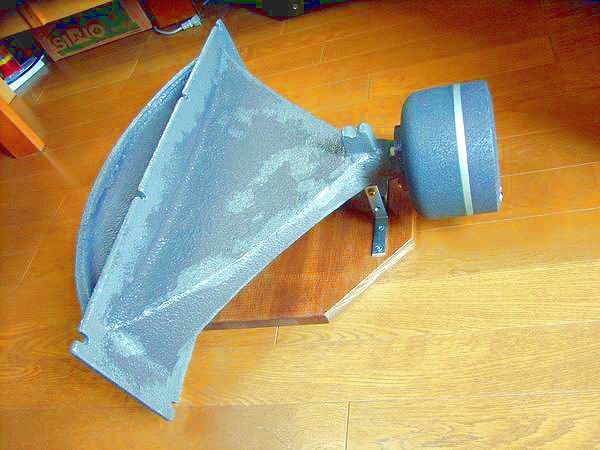 This is the fixing plate of the driver with horn. Its dimension is 35cm x 30cm x 2cm.
 The volume of enclosure is about 150 liters. I got red JBL emblem by net auction, but it
was too small.
The volume of enclosure is about 150 liters. I got red JBL emblem by net auction, but it
was too small.
 The sound of JBL speaker system with compression driver type is very powerful and
splendid as I expected.
The sound of JBL speaker system with compression driver type is very powerful and
splendid as I expected.
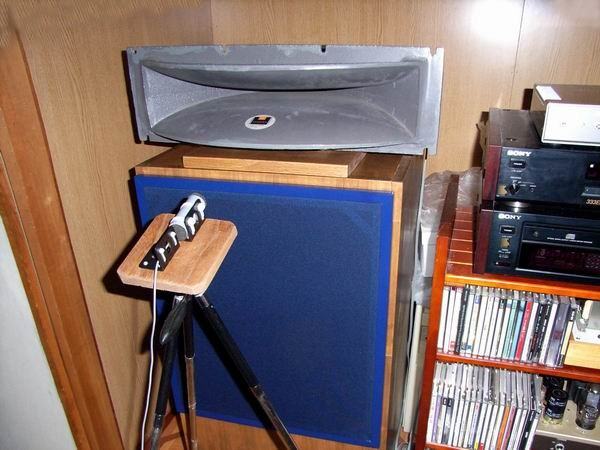 This is measuring scene with a hand-made microphone. The frequency response of the
microphone will be 30 Hz to 15 kHz.
This is measuring scene with a hand-made microphone. The frequency response of the
microphone will be 30 Hz to 15 kHz.
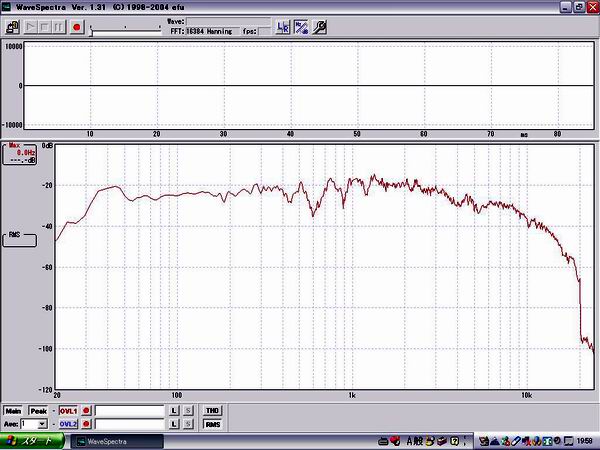 This is the overall frequency response of JBL speaker system with 3110 network.
The cross-over part at about 800 Hz seems to be smooth.
This is the overall frequency response of JBL speaker system with 3110 network.
The cross-over part at about 800 Hz seems to be smooth.
 I measured the frequency response of individual speaker unit, woofer and driver.
The cross-over frequency will be about 790 Hz. The part of less than 200 Hz is not the characteristic
of driver, but it is background noise derived from PC fan and hum noises.
I measured the frequency response of individual speaker unit, woofer and driver.
The cross-over frequency will be about 790 Hz. The part of less than 200 Hz is not the characteristic
of driver, but it is background noise derived from PC fan and hum noises.
 This is the frequency response of the bass reflection duct. The resonance frequency seems
to be 40 Hz.
This is the frequency response of the bass reflection duct. The resonance frequency seems
to be 40 Hz.
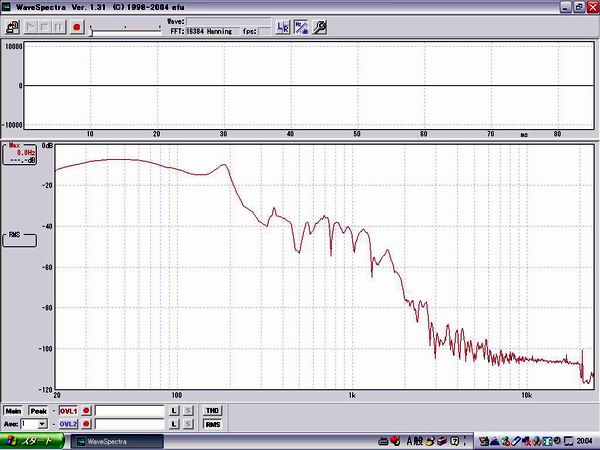 This is the frequency response of inside enclosure. There is no outstanding peak by
standing waves.
This is the frequency response of inside enclosure. There is no outstanding peak by
standing waves.
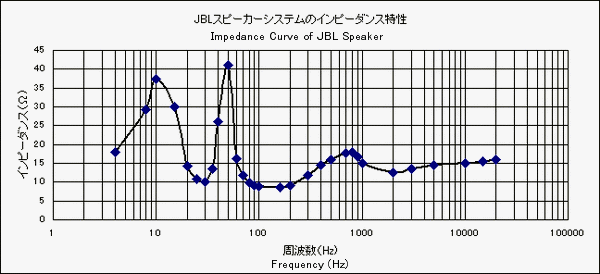 This is the impedeance characteristic of JBL speaker system with 3110 network.
The minimum impedance in the alternate frequency is read as 8 Ohms.
The DC resistance is 7.6 Ohms. The resonance frequency is read as 30 Hz.
This is the impedeance characteristic of JBL speaker system with 3110 network.
The minimum impedance in the alternate frequency is read as 8 Ohms.
The DC resistance is 7.6 Ohms. The resonance frequency is read as 30 Hz.
Subsequent reconstruction: Improvement of the high region characteristic by tweeter addition
 Although my ear could seldom be heard the sound of 10kHz or more with aging, I thought that
the speaker system would be improved if the tweeter is added. I got two pieces of FT90H of
Fostex through the online auction.
Although I wanted JBL tweeters in fact, since I need much money, I gave it up.
The major characteristics of FT90H are as follows:
Although my ear could seldom be heard the sound of 10kHz or more with aging, I thought that
the speaker system would be improved if the tweeter is added. I got two pieces of FT90H of
Fostex through the online auction.
Although I wanted JBL tweeters in fact, since I need much money, I gave it up.
The major characteristics of FT90H are as follows:
Maximum input power:50W
Impedance:8 ohms
Sound pressure:106dB/W/m
Frequency response:5kHz to 35kHz
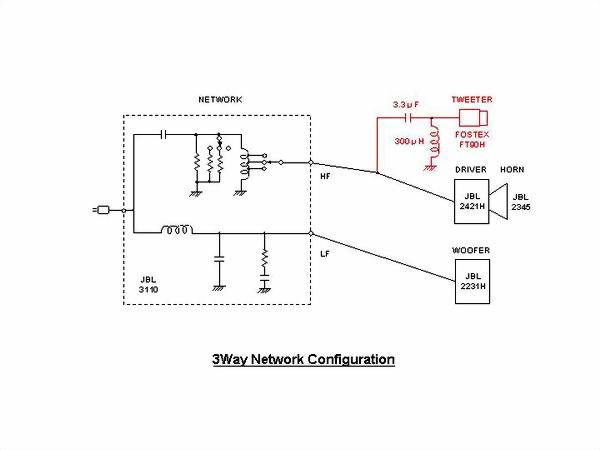 This is the circuit diagram of the 3-Way system.
Since the efficiency of FT90H is close to the driver, the HPF by L and C was only connected to
the driver for simplification.
C is 3.3 μF and L is 300 μH, thus the crossover frequency is about 5kHz on calculation.
This is the circuit diagram of the 3-Way system.
Since the efficiency of FT90H is close to the driver, the HPF by L and C was only connected to
the driver for simplification.
C is 3.3 μF and L is 300 μH, thus the crossover frequency is about 5kHz on calculation.
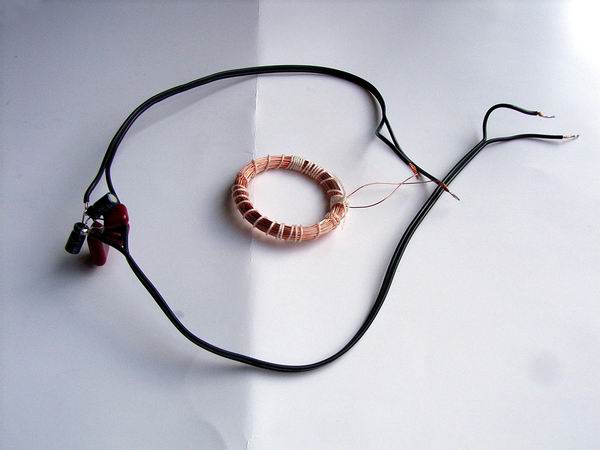 These are the network parts for super-poor men.
It is the coil made from the enameled wire of 0.4mm in diameter, and 10m in length which I bought.
The number of turns was well adjusted so that the series resonance frequency might
become to 5kHz and it bundled with thread.
These are the network parts for super-poor men.
It is the coil made from the enameled wire of 0.4mm in diameter, and 10m in length which I bought.
The number of turns was well adjusted so that the series resonance frequency might
become to 5kHz and it bundled with thread.
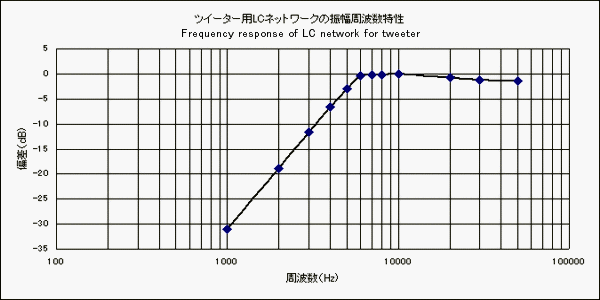 This is the frequency response of LC network for tweeter under 8-ohm load.
The minimum insertion loss is about 1dB at 10kHz.
The graph is drawn considering 10kHz loss as 0dB.
The insertion loss at 5kHz is about 3dB just as designed.
The inclination of the curve also serves as about 12dB/octave.
This is the frequency response of LC network for tweeter under 8-ohm load.
The minimum insertion loss is about 1dB at 10kHz.
The graph is drawn considering 10kHz loss as 0dB.
The insertion loss at 5kHz is about 3dB just as designed.
The inclination of the curve also serves as about 12dB/octave.
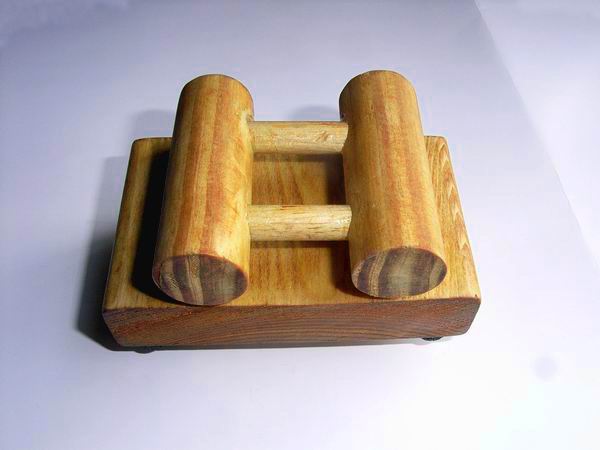 This is the wood base of the tweeter I made and painted with vanish.
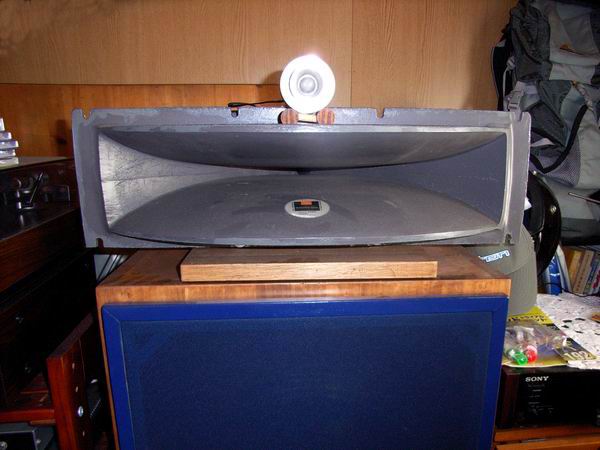 This is new 3-way speaker system after the addition of tweeter.
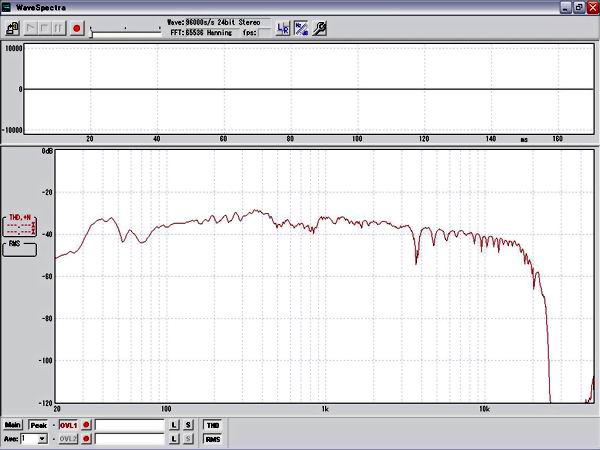 This is the total frequency response of 3-Way speaker system. It is clear that high frequency region is
improved. Also me in whom hearing ability declined, it turned out that the range of sound became
wide.
This is the total frequency response of 3-Way speaker system. It is clear that high frequency region is
improved. Also me in whom hearing ability declined, it turned out that the range of sound became
wide.