| 300B Single Trans-Driven Amplifier |
In the past I had the experience of making a 300 B transformer coupled amplifier using 6BM8, but since I got a complex type twin triode of 6CS7, I hope that it will produce a better sound than triode connection of pentode tube, I am remodeling the amplifier. Although the sound of the transformer coupled amplifier is not Hi-Fi, it seems to be lively sound for elderly people whose hearing has declined because energy concentrates in the midrange.
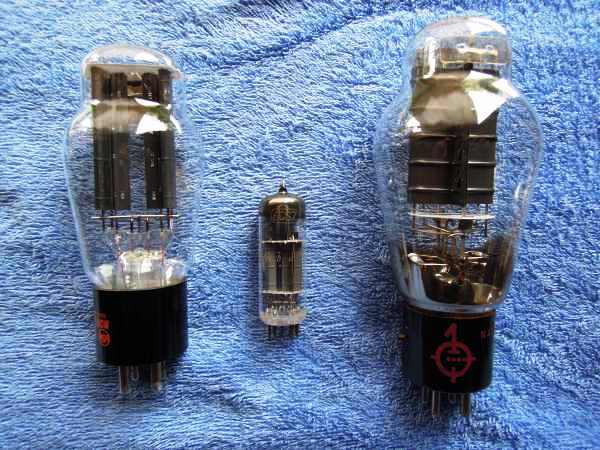 It is RCA made 5Z3, Toshiba made 6CS7 and China National made 300B. 6CS7 contains two different
types of triode tubes, according to the specification table, voltage amplification of μ = 17
and voltage (or power) amplification of μ = 15.5 are possible. The plate resistance is also
small as 7.7 kΩ and 3.45 kΩ, respectively, and the linearity seems to be good. Allowable plate
loss is easy to use as driver tube at 1.25 W, 6.5 W respectively.
It is RCA made 5Z3, Toshiba made 6CS7 and China National made 300B. 6CS7 contains two different
types of triode tubes, according to the specification table, voltage amplification of μ = 17
and voltage (or power) amplification of μ = 15.5 are possible. The plate resistance is also
small as 7.7 kΩ and 3.45 kΩ, respectively, and the linearity seems to be good. Allowable plate
loss is easy to use as driver tube at 1.25 W, 6.5 W respectively.
If you put the mouse over the image, it will be
enlarged. (Same below)
 It is the front of 300B single transformer coupled amplifier. I installed the driver transformer
in the place where the ammeter was. Because vacuum tubes can not be increased any more in terms
of space, only composite tubes can be used.
It is the front of 300B single transformer coupled amplifier. I installed the driver transformer
in the place where the ammeter was. Because vacuum tubes can not be increased any more in terms
of space, only composite tubes can be used.
 It is remodeling after the remodeling, so the aerial wirings are not beautiful. For the LM317
of the constant current IC, I installed a heat sink.
It is remodeling after the remodeling, so the aerial wirings are not beautiful. For the LM317
of the constant current IC, I installed a heat sink.
 It is 300B circuit diagram of single transformer coupled amplifier. Since the internal resistance
of 6CS7 is close to 5 kΩ, both the primary and secondary coils of NC14 were connected in series.
In the transformer coupled amplifier, impedance matching with the driver tube is important, as
the characteristics of the driver transformer are the deciding factor. When trying the cathode
resistance by cut and try, the optimum matching was achieved with 1.15 kΩ (1.5 k and 5.1 k
connected in parallel). The plate current of 300B is constant current to about 60 mA. Naturally
it is all triode tube amplifier, so negative feedback is not necessary.
It is 300B circuit diagram of single transformer coupled amplifier. Since the internal resistance
of 6CS7 is close to 5 kΩ, both the primary and secondary coils of NC14 were connected in series.
In the transformer coupled amplifier, impedance matching with the driver tube is important, as
the characteristics of the driver transformer are the deciding factor. When trying the cathode
resistance by cut and try, the optimum matching was achieved with 1.15 kΩ (1.5 k and 5.1 k
connected in parallel). The plate current of 300B is constant current to about 60 mA. Naturally
it is all triode tube amplifier, so negative feedback is not necessary.
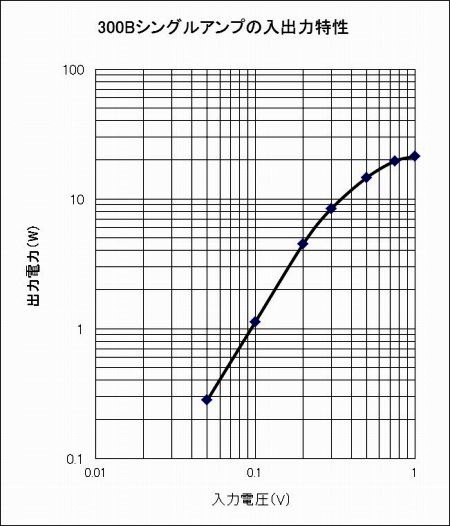 It is 1 kHz input/output characteristic of 300B single transformer coupled amplifier. The amplifier
gain is about 30 times. Virtual calculation yields 6CS7 x 300 B x output transformer = 160 x 4 x
1/21 = 30. Linearity is kept until the output is about 8 W, and if I ignore some distortion it can
be taken out to about 15 W. As expected, transformer coupling seems to be able to drive until
300B grid becomes positive area. The damping factor at 1 kHz is 3.6 as measured by the on-off method.
Residual noise is a bit bigger at 1 mV but I can not hear it unless I close your ears to the speaker.
It is 1 kHz input/output characteristic of 300B single transformer coupled amplifier. The amplifier
gain is about 30 times. Virtual calculation yields 6CS7 x 300 B x output transformer = 160 x 4 x
1/21 = 30. Linearity is kept until the output is about 8 W, and if I ignore some distortion it can
be taken out to about 15 W. As expected, transformer coupling seems to be able to drive until
300B grid becomes positive area. The damping factor at 1 kHz is 3.6 as measured by the on-off method.
Residual noise is a bit bigger at 1 mV but I can not hear it unless I close your ears to the speaker.
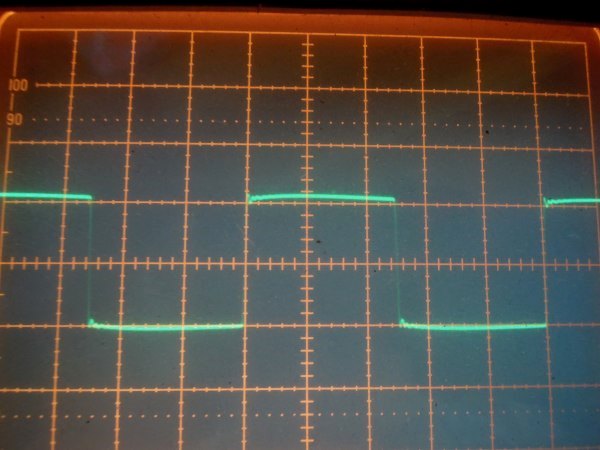
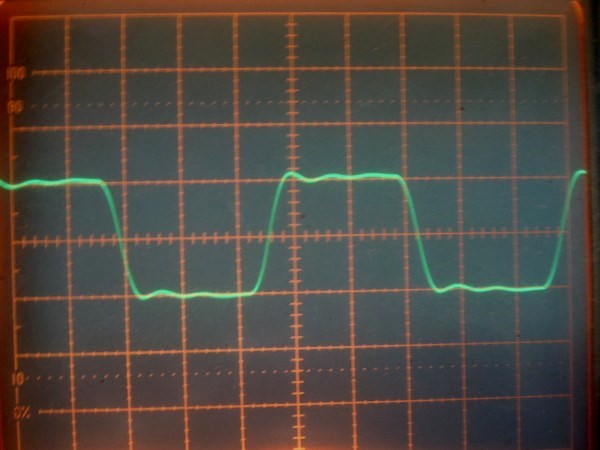
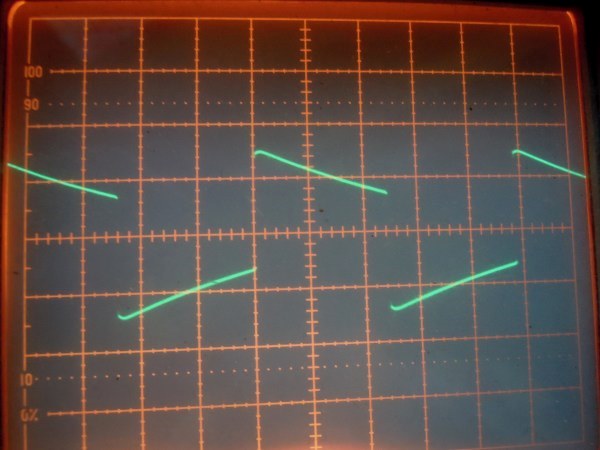 It is 300B square wave response waveform at 2Vp-p of transformer coupled amplifier. It is 100 Hz,
1 kHz, 10 kHz from the top, ringing is seen in the 1 kHz and 10 kHz waveforms because there is a
slight peak in the high frequency region of frequency characteristic. I think that the response of
10 kHz became the most beautiful because I made the best impedance matching between the driver
tube and the driver transformer. Although it is a little narrow band characteristic, the amazing
sound that gathered energy in the midrange is my favorite sound.
It is 300B square wave response waveform at 2Vp-p of transformer coupled amplifier. It is 100 Hz,
1 kHz, 10 kHz from the top, ringing is seen in the 1 kHz and 10 kHz waveforms because there is a
slight peak in the high frequency region of frequency characteristic. I think that the response of
10 kHz became the most beautiful because I made the best impedance matching between the driver
tube and the driver transformer. Although it is a little narrow band characteristic, the amazing
sound that gathered energy in the midrange is my favorite sound.